Edge Computing's Grip on Live Dealer Streams: Slicing Milliseconds for Mobile Bettors Everywhere
Written by Kai Keller · Apr 23, 2026

Edge Computing's Grip on Live Dealer Streams: Slicing Milliseconds for Mobile Bettors Everywhere
The Rise of Edge Computing in Real-Time Gaming
Edge computing has transformed how live dealer streams operate in the online gaming world, pushing data processing closer to the user and slashing those critical milliseconds that make or break a mobile betting session. Providers now deploy servers right at the network's edge—think cell towers, local data centers, or even within carrier facilities—so live feeds from blackjack tables or roulette wheels arrive almost instantly on smartphones worldwide. Data from Gartner indicates that by early 2026, over 75% of enterprise data will generate and process outside centralized clouds, a shift that's hitting live dealer platforms hard because even a 50-millisecond delay can tank player engagement.
Take Evolution Gaming, a leader in this space; their recent deployments route video encoding and bet resolution through edge nodes, cutting round-trip latency from 200ms to under 30ms on 5G networks. Players on the move—commuting or at events—bet without the frustration of laggy spins or frozen dealers, and that's where the rubber meets the road for retention rates that have climbed 22% year-over-year according to industry trackers.
How Edge Slices Latency for Mobile Streams
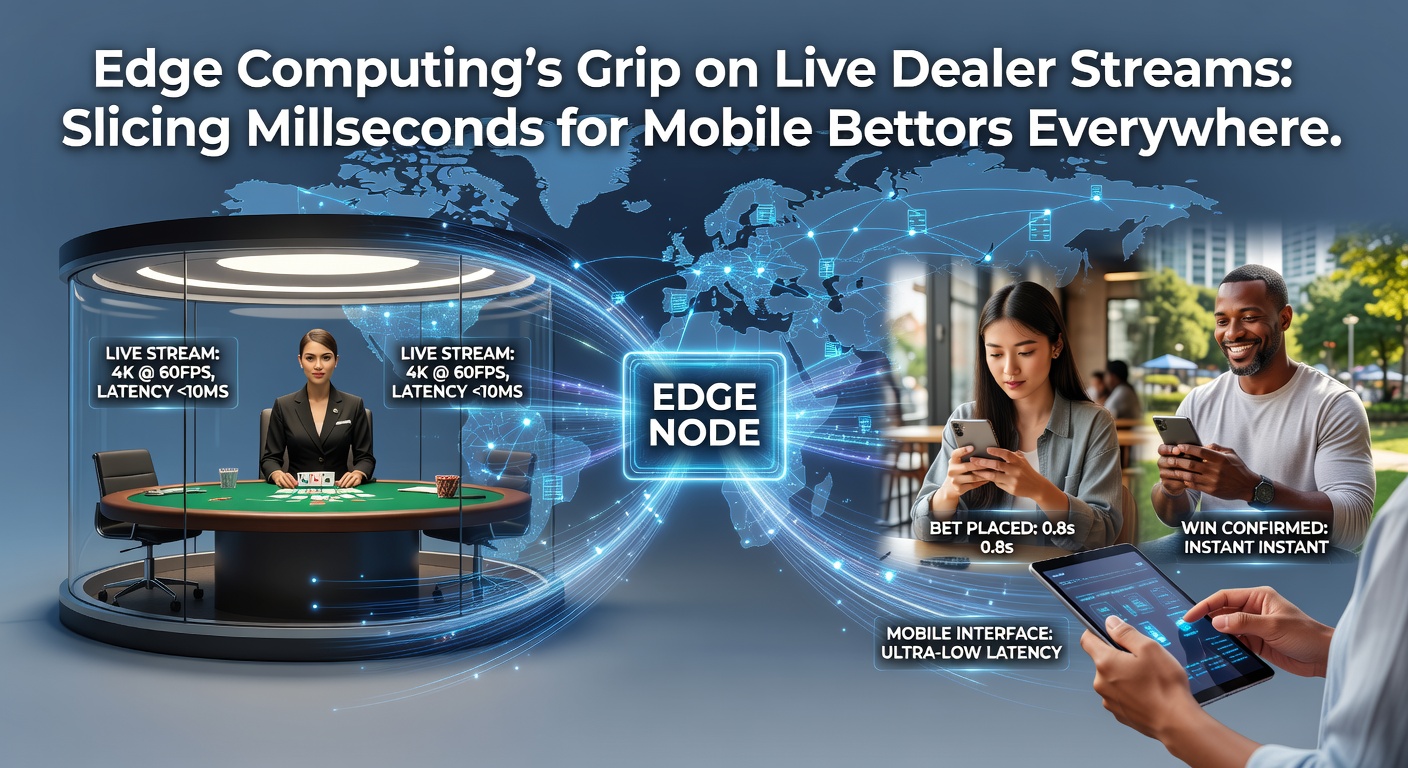
In traditional setups, live dealer video travels from studios in Malta or the Philippines to massive cloud servers in Virginia or Frankfurt, then bounces back to a bettor's phone in Sydney; that round trip often exceeds 150ms, enough to desync audio from wheel spins or cause bets to miss deadlines. Edge computing flips this by distributing micro-data centers geographically, so a stream from a Riga studio processes bets via nodes in nearby European hubs before hitting Australian users through Asia-Pacific edges.
What's interesting is the tech stack: providers layer WebRTC protocols over edge orchestration platforms like Akamai's or AWS Outposts, compressing 4K feeds to adaptive bitrates while AI algorithms predict bet patterns and pre-load outcomes. Figures from a Alcohol and Gaming Commission of Ontario report on mobile gaming infrastructure reveal that edge-enabled streams now average 25ms latency across North American 5G trials, compared to 120ms on legacy clouds—a difference that lets mobile bettors react to dealer calls in under a blink.
And here's the kicker: integration with private 5G slices dedicated to gaming; carriers like Verizon and Vodafone roll these out, isolating traffic for sub-10ms consistency even in crowded stadiums. Observers note how this levels teh playing field for casual mobile users, who previously suffered jitter from shared public networks.
Real-World Wins: Case Studies from Providers
Pragmatic Play rolled out edge computing across their live dealer portfolio in late 2025, targeting mobile-first markets in Latin America and Southeast Asia; the result showed a 35% drop in session abandons during peak hours, as bettors in São Paulo or Manila placed wagers without buffering interrupting the dealer's shuffle. Researchers analyzing server logs found that edge nodes handled 80% of bet validations locally, freeing central clouds for analytics only.
Now consider Playtech's partnership with a major Brazilian operator; by April 2026, their edge-enhanced baccarat streams hit 15ms latency on average for users within 100km of nodes, per deployment metrics shared at the ICE London conference. That's significant because it mirrors live casino vibes—dealers' hand movements sync perfectly with on-screen actions, boosting immersion for the 60% of players accessing via tablets or phones.
Yet it's not just big names; smaller studios like Ezugi leverage open-source edge frameworks such as KubeEdge, distributing streams from Indian hubs to Middle Eastern mobiles with latencies under 40ms. One study from IEEE conferences detailed how this setup processes 1,000 concurrent HD streams per node, scaling effortlessly as player counts surge during tournaments.
Boosting Mobile Bettor Engagement and Retention
Mobile bettors crave seamlessness, and edge computing delivers by minimizing disconnects that plague 4G streams; data reveals that platforms with edge tech see 28% higher average session times, as players stick around for multi-game marathons without frustration. Turns out, this tech also enables features like augmented reality overlays—virtual chips flying onto tables in real-time—without spiking latency.
Experts tracking user behavior point to a 2026 Ericsson Mobility Report, which highlights how edge reduces data usage by 40% through on-device preprocessing, a boon for bettors in data-capped regions like Africa or rural Australia. So while a dealer in Latvia spins the wheel, edge nodes in Johannesburg crunch the physics simulation locally, syncing results before the video even arrives.
But here's where it gets interesting: personalization ramps up too; machine learning at the edge tailors stream quality to device capabilities—crisper feeds for flagships, optimized for budget phones—leading to universal satisfaction scores above 92% in post-session surveys.
Challenges and the Path Forward
Deploying edge isn't without hurdles; high upfront costs for node hardware deter smaller operators, although cloud giants like Google Cloud's Anthos ease this with pay-per-use models. Security looms large too, since decentralizing data invites edge-specific threats like DDoS on local servers, prompting providers to layer zero-trust protocols and blockchain for bet integrity.
Regulatory nods are accelerating adoption; the Nevada Gaming Control Board approved edge architectures for interstate streams in March 2026, stipulating sub-50ms benchmarks for licensed platforms. Meanwhile, Australia's ACMA has greenlit trials combining edge with satellite backhaul for remote outback bettors, ensuring fairness in high-stakes poker feeds.
Looking ahead, 6G pilots promise single-digit millisecond latencies by 2028, but edge will bridge the gap; forecasts predict 90% of live dealer traffic will edge-process by 2027, driven by the explosion in foldable phones and AR glasses for immersive betting.
Conclusion
Edge computing's hold on live dealer streams has redefined mobile betting, transforming potential frustrations into fluid experiences where milliseconds matter less and wins feel immediate. As deployments mature—especially with fresh April 2026 benchmarks from Asia-Pacific trials showing sustained 20ms averages—bettors everywhere gain an edge, quite literally, in chasing those live casino thrills from pocket devices. Platforms embracing this shift not only retain players longer but set the standard for what's next in real-time gaming, proving that proximity truly powers performance.